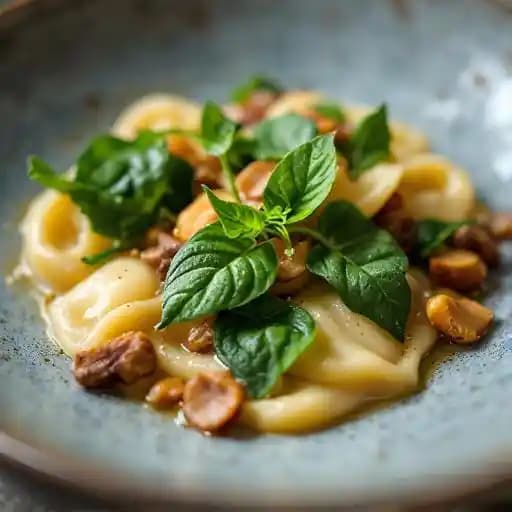
Vicia Faba Recipe
Early Spring Fava Agnolotti, White Truffle Crème, Yellow Foot Chanterelles and Braised Guanciale. Chef’s Notes: Consider the humble fava bean. Having a recorded history in the eastern Mediterranean as far back as 6000 BC, its presence is felt in almost every culture on the globe. Not only prized for its culinary uses, its importance as a pollinator and nitrogen fixing cover crop have been recognized for centuries. It should seem fitting that such an ancient food also be one of the most beloved harbingers of spring. Drawing from the tender early spring leaves, we create a little pasta pillow, lovingly nestled in white truffle cream with delicate yellow foot chanterelles and pan-crisped slow braised guanciale.
Was this page helpful?
Help improve this recipe for others.
Send this recipe to your inbox.
We'll email it straight to you - plus weekly cooking inspiration.
Ingredients
Some product links may be affiliates. If you buy through them, you're supporting the site and Pekin may earn a commission at no extra cost to you.
Pasta Dough
Fava Filling
White Truffle Crème
Chanterelles & Guanciale
Finishing & Assembly
Method
Pasta Dough
- 1
- 2
- 3
Wrap the dough tightly in plastic and rest in the refrigerator for at least 30 minutes (up to 2 hours). This relaxes the gluten and makes rolling easier.
Fava Filling
- 4
Blanch the shelled fava beans in salted boiling water for 60–90 seconds until bright green and tender. Shock immediately in an ice bath to stop cooking.
- 5
Strip the outer skins from each fava (for young beans you may skip this, but skinned beans will yield a smoother filling).
- 6
- 7
Transfer the warm favas to a food processor with the drained ricotta, grated ricotta salata (or Pecorino), chopped mint, lemon zest and juice, 1/2 tsp salt, and 1/4 tsp black pepper. Pulse until a coarse-smooth purée remains; you want a little texture so the filling isn't completely uniform. Taste and adjust seasoning.
- 8
Chill the filling in the refrigerator for 15–20 minutes to firm slightly, which helps when portioning for agnolotti.
Shaping Agnolotti
- 9
Divide rested pasta dough into 4 pieces. Keep pieces covered. Working with one piece at a time, flatten and run through a pasta machine on the widest setting several times, folding once between passes, until smooth.
- 10
Gradually reduce the machine setting to a thin sheet (about setting 6–7 on most machines) — thin but not translucent. Dust lightly with semolina or flour to prevent sticking.
- 11
Using a teaspoon or a piping bag, place 1 tsp mounds of chilled fava filling along the pasta sheet spaced about 1"–1 1/4" apart. Brush a thin line of water or beaten egg around each mound to seal.
- 12
Fold the sheet over the filling lengthwise, pressing gently around each mound to expel air and form pillows. Use a fluted pastry wheel or sharp knife to cut between pillows into individual agnolotti (approx 1 1/4" × 1" pillows). Press edges to seal. Transfer to a lightly floured tray and keep covered while finishing remaining dough.
White Truffle Crème
- 13
In a small saucepan, melt 1 tbs butter over medium-low heat. Add the minced shallot and sweat gently until translucent but not colored, about 2–3 minutes.
- 14
Add the cream and milk, bring to a gentle simmer, and cook until slightly reduced and thickened enough to coat a spoon, about 8–10 minutes. Stir occasionally.
- 15
Remove from heat and whisk in the grated Parmigiano-Reggiano until smooth. Season with 1/4 tsp salt and 1/8 tsp white pepper. Stir in 1/2 tsp white truffle oil, tasting cautiously — truffle oil is potent.
- 16
Keep warm on very low heat or hold in a warm water bath; do not boil after adding truffle oil or cheese to avoid breaking.
Chanterelles & Guanciale
- 17
- 18
- 19
- 20
Add the thyme leaves, a pinch (1/4 tsp) of salt and a little cracked black pepper. Continue sautéing until mushrooms are golden and just tender, about 2 more minutes. Finish with the reserved crispy guanciale, toss to combine, then remove from heat and keep warm.
Cook & Finish
- 21
Bring the pot of salted water to a gentle rolling boil. Add the agnolotti in batches (do not overcrowd) and cook until they float and are al dente, about 2–3 minutes for fresh thin pasta. Timing will depend on thickness—test one.
- 22
While agnolotti cook, warm the truffle crème gently. When agnolotti are cooked, use a slotted spoon to transfer them directly into the warm truffle crème. Add 1 tbs cold butter and 1/2 tsp extra-virgin olive oil to the sauce and gently toss (off heat) to emulsify and coat the pasta—this gives sheen and rounds flavors.
- 23
Divide the agnolotti and sauce between 4 warm plates. Spoon the chanterelles and guanciale over and around the agnolotti.
- 24
Finish each plate with a light drizzle of additional white truffle oil if desired (a few drops), a sprinkle of freshly grated Parmigiano-Reggiano, microgreens or chervil, and a final crack of black pepper. Adjust sea salt to taste.