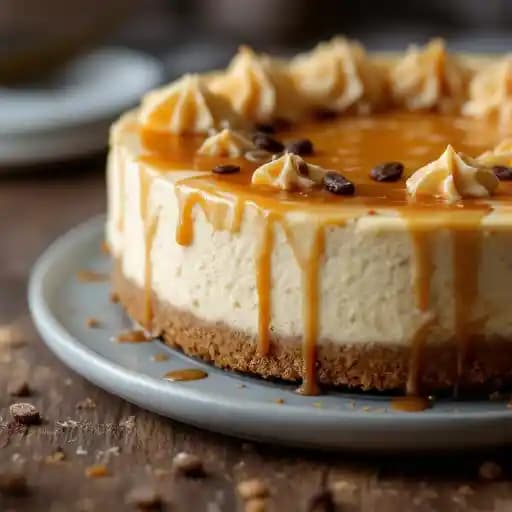
Vanilla Bean Cheesecake Recipe
Graham cracker crust, dulce de leche, brûléed vanilla cream
Was this page helpful?
Help improve this recipe for others.
Send this recipe to your inbox.
We'll email it straight to you - plus weekly cooking inspiration.
Ingredients
Some product links may be affiliates. If you buy through them, you're supporting the site and Pekin may earn a commission at no extra cost to you.
Graham Cracker Crust
Vanilla Bean Cheesecake Filling
Dulce de Leche Layer
Brûléed Vanilla Cream Topping
Method
Graham Cracker Crust
- 1
- 2
Place graham crackers in a food processor and pulse to fine crumbs (about 1 3/4 cups). Alternatively, place in a zip-top bag and crush with a rolling pin.
- 3
Melt the unsalted butter and stir together with the graham cracker crumbs, 2 tablespoons granulated sugar, and 1/4 teaspoon salt until mixture holds together when pinched.
- 4
Press the crumb mixture firmly and evenly into the bottom and about 1/2 inch up the sides of the prepared springform pan to form a compact crust.
- 5
Bake crust for 8–10 minutes until set and aromatic. Remove from oven and let cool while preparing the filling. Reduce oven temperature to 325°F (160°C).
Vanilla Bean Cheesecake Filling
- 6
Lower oven temperature to 325°F (160°C) if not already set. Prepare a large roasting pan for a water bath: have hot water ready to pour later.
- 7
Prepare the cream cheese
In a large mixing bowl or the bowl of a stand mixer fitted with the paddle attachment, beat the room-temperature cream cheese on medium speed until very smooth and free of lumps, about 2–3 minutes. Scrape down the bowl as needed.
- 8
Add sugar and aromatics
Add 1 cup granulated sugar and 1/2 teaspoon fine sea salt to the cream cheese and beat until combined and smooth, another 1–2 minutes. Scrape the bowl. Add the vanilla bean seeds (scrape seeds from 1 vanilla bean) or 1 teaspoon vanilla paste and the optional lemon zest; mix briefly to incorporate.
- 9
Incorporate sour cream and milk
Add 1 cup sour cream and 2 tablespoons whole milk. Beat on low speed until smooth and uniform, about 30 seconds. Scrape down the bowl.
- 10
Add eggs
With the mixer on low speed, add the eggs one at a time, mixing just until incorporated after each addition. Then add the additional yolk and mix until just uniform. Take care not to overmix to minimize air incorporation.
- 11
Pour about half of the filling over the cooled crust, smoothing the surface. Spoon the dulce de leche evenly over the filling, leaving a 1/4–1/2 inch border from the edge to prevent it from running. Pour the remaining filling over the dulce de leche and gently smooth to cover. Use a spatula to swirl slightly if you like a marbled effect, but avoid heavy mixing.
- 12
Cover the outside bottom of the springform pan with a double layer of heavy-duty aluminum foil (to prevent water seeping in). Place the filled springform pan into the prepared roasting pan. Carefully pour hot (not boiling) water into the roasting pan to come halfway up the sides of the springform pan (about 1–1.5 inches).
- 13
Bake at 325°F (160°C) for 55–70 minutes. The edges should be set and lightly puffed; the center should still have a slight jiggle when gently shaken. Avoid overbaking to prevent cracks.
- 14
Turn off the oven and crack the oven door. Let the cheesecake cool in the turned-off oven for 1 hour to finish setting slowly. This reduces cracking.
- 15
Remove the cheesecake from the water bath and discard the foil. Run a thin knife around the inside edge of the springform to loosen (do not remove the sides yet). Let the cake cool to room temperature on a wire rack, then refrigerate uncovered for at least 6 hours or preferably overnight to chill and firm fully.
Brûléed Vanilla Cream Topping
- 16
About 30–60 minutes before serving (once cheesecake is fully chilled), prepare the vanilla cream: in a medium bowl, whisk together 1 cup heavy cream, the seeds from 1/2 vanilla bean (or 1/2 teaspoon vanilla paste), 1 teaspoon powdered sugar (optional, helps stabilize), and 1/8 teaspoon fine sea salt until slightly thickened but still pourable. You can briefly whip to soft peaks but keep it pourable for an even surface.
- 17
Pour or gently spread the vanilla cream over the chilled cheesecake to create a smooth 1/8–1/4-inch layer. Return to refrigerator for 20–30 minutes to firm slightly so sugar will sit on top and not dissolve.
- 18
Just before serving, evenly sprinkle 1/2 cup granulated sugar over the chilled vanilla cream layer. Use a kitchen blowtorch to brûlée the sugar: move the torch in small circular motions at medium-high flame until sugar melts and forms an amber-brown caramelized crust. Be careful to avoid browning the cream beneath; keep the torch about 2–3 inches away and rotate continually for even color.
- 19
Without a torch (broiler method)
If you don't have a torch: place the cheesecake (still in springform, on a baking sheet) under a very hot broiler set 6–8 inches from the heat. Watch constantly and broil 1–3 minutes until sugar melts and caramelizes. Remove immediately to avoid overheating the cream. Note: this may warm top slightly.
- 20
Allow the brûléed sugar to rest for 5–10 minutes to harden, then remove the springform sides. Transfer to a serving plate, slice with a hot, dry knife (wipe between cuts) and serve. Store leftovers refrigerated; the caramel crust will soften over time.